I'm loving the style of these. The rotation path of the satellite might look more convincing if you slow it down as it reaches the bottom left-most position, like it does with the top right.
Would love to see the satellite's texture rotating, like the planets, too. It's quite noticeable that it's a single frame, there.
I agree with other commenters, it does seem to jerk about a bit - Easing at the apexes would help.
Other things to consider: darken and scale the satellite slightly on the return path.
Flash is fantastic for this sort of animation (although its texture rendering is abysmal). After effects would be the ultimate application, although the learning curve is much steeper.
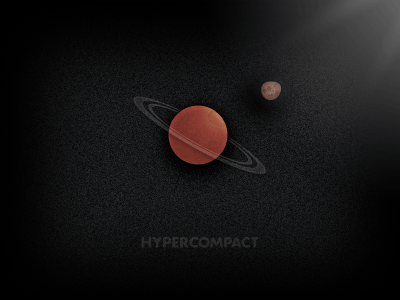
I intentionality made the orbit in this way as the gravitational pull from the primary body would sling the little guy around at different velocities. According to my vastly inadequate knowledge, the satellite would speed up when it's orbit reached a shorter distance.
The craters on the asteroid should definitely rotate. If you'll notice, I made it appear darker when it's behind the planet, as the star in this solar system is at the top right of the frame.
Then (and please tell me to stfu here) I'd lean towards the other side of the loop and have that start to slow down as soon as it slingshots around the closer part of the orbit.
Love the rotation of elements on the planet. The satellite itself feels a bit flat, I might try having it be a bit more shadowed as its orbit brings it behind the planet away from the light source. As always, love seeing your work.
17 Responses
Here's the second animation in the series for our first Hypercompact app. A random satellite around a fictitious planet.
over 1 year ago
This is amazing. I can watch this all day. It does not look like a satellite. Looks more like a rock?
over 1 year ago
Now I'm dizzy. Love it!
over 1 year ago
Well technically a 'Satellite' is what you call any body orbiting around a planet.
Go science.
over 1 year ago
@ Russ: Depends on if it is a Natural Satellite or an Artificial Satellite.
over 1 year ago
@Riley I learn more on Dribbble than in school.
over 1 year ago
I'm loving the style of these. The rotation path of the satellite might look more convincing if you slow it down as it reaches the bottom left-most position, like it does with the top right.
Would love to see the satellite's texture rotating, like the planets, too. It's quite noticeable that it's a single frame, there.
over 1 year ago
Rebound
Planetary
by Andy Birchwood
I agree with other commenters, it does seem to jerk about a bit - Easing at the apexes would help.
Other things to consider: darken and scale the satellite slightly on the return path.
Flash is fantastic for this sort of animation (although its texture rendering is abysmal). After effects would be the ultimate application, although the learning curve is much steeper.
over 1 year ago
Strong.
over 1 year ago
@Russ "I learn more on Dribbble *THAN* in school".. now you've learned two things today..
over 1 year ago
so beautiful! nice work.
over 1 year ago
@Andreas you beat me to it.
over 1 year ago
Thanks dudes, and thanks for the feedback!
I intentionality made the orbit in this way as the gravitational pull from the primary body would sling the little guy around at different velocities. According to my vastly inadequate knowledge, the satellite would speed up when it's orbit reached a shorter distance.
The craters on the asteroid should definitely rotate. If you'll notice, I made it appear darker when it's behind the planet, as the star in this solar system is at the top right of the frame.
over 1 year ago
Ah yes. I see :)
Then (and please tell me to stfu here) I'd lean towards the other side of the loop and have that start to slow down as soon as it slingshots around the closer part of the orbit.
Quickie: http://dl.dropbox.com/u/604868/in_orbit.gif
over 1 year ago
^ that's space for ya
over 1 year ago
So awesome!
over 1 year ago
Love the rotation of elements on the planet. The satellite itself feels a bit flat, I might try having it be a bit more shadowed as its orbit brings it behind the planet away from the light source. As always, love seeing your work.
over 1 year ago