


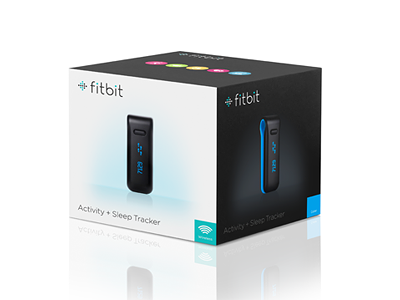
This was a packaging design exploration I started a few months ago. I nixed it for several reasons, and we ended up using an outside vendor to design our latest packaging. But I decided to finish up the concept this weekend. I still like it, but it's probably impractical for a number of reasons.
The device is indeed small. But we had some competing goals with our packaging redesign too, which led me to explore some different sizes and shapes — some bigger, some smaller.
Reasons to "Make it bigger"
Our original box was pretty small, small enough in fact to be slipped into an oversized coat pocket. So exploring larger sizes became a way to combat theft in the retail environment.
Our marketing team wanted to tell the story better of what this product is and does. Therefore, we increased the "billboard" space to communicate the product benefit both graphically and textually. (fwiw, I'm not really doing that in this design, as I prefer a tactic where the impact of the imagery catches the potential customer's eye and gets them to pick it up and read further. Funny, I was just reading Young & Rubicam's definition of "impact" this morning: "The quality of an advertisement which strikes suddenly against the reader's indifference and enlivens his mind to receive a sales message.")
I was in fact using the cube shape to entice retailers to give us an even bigger billboard. Four of the panels on the cube portray a different photo/view of the device, but the branding is identical on each side, so any side could be displayed outward, and retailers could make a pattern that's visually enticing (I'll try to post an example of that later). This was somewhat impractical, though, since you can't assume retailers are giving you that much shelf real estate; quite the opposite usually.
Lastly, the Fitbit Tracker is really small, about the size of a Bic lighter. But there are a few accessories included, so they would occupy some of the space.
"Make it smaller"
As I mentioned, it's not easy to ask retailers to give you more shelf space. This is part of why we explored smaller boxes too (although I'm not showing any here). The one we ended up with is in fact thinner and taller, and takes up probably about 2/3 the volume of the pictured design.
After I'd done the exploration pictured here, I learned that one of our biggest retailers needed the box to be thinner because there was still a possibility they'd insist on putting it inside a clear plastic security box. (I know, that defeats the purpose of making it bigger so it's harder to steal. Don't try using logic on these people.)
Smaller is also better for shipping and storage. It's a lot less costly to ship or store 60 boxes in a carton than 40. No to mention the carbon consumption that adds up to. Which leads me to...
Trying to reduce the packaging materials to be more environmentally friendly. Our original box had a lot of acrylic plastic. I wanted to reduce that a lot (or totally, in the case of this design) because it's costly to make and very hard / impossible for the consumer to recycle. So it ends up in the landfill.
Sorry for the novel : ) I hope this answered your question.
Thanks for the explanation. I like the simplicity of the design and I can see how enticing the billboard can be when you have these boxes lining up in different panels. It reminds me the package design from the 1st gen iPod.
I kinda like the current package you have, very simliar to the ipad nano design. It's small and slim just like the fitbit device.
i really liked the first fitbit package, I've kept both of mine cause I loved it so much. This cube concept reminds me of the old iPod mini packages. They were a bunch bigger than teh actual product for that generation yet had similar design cues and told stories on each face.
they also stacked well which my retail experience tells me is good and bad like you stated above. But just for the record if I was making a larger display out of these types of boxes (and I have) i was quite specific about it and was gratified by the impact it had, even with as little as 4 units on a counter top.
This is an example of how the square box was designed to maximize the billboard effect in the retail environment. Each of the sides, including even the top, can be displayed outward, imparting information about the product such as alternate photos or product features.
For more info, see the original shot this is a rebound of.
9 Responses
Pro
Mark Bult
This was a packaging design exploration I started a few months ago. I nixed it for several reasons, and we ended up using an outside vendor to design our latest packaging. But I decided to finish up the concept this weekend. I still like it, but it's probably impractical for a number of reasons.
over 1 year ago
Pro
Jason Wu
I remember the device is fairly small and thin. Any reason to design the package in a cubical shape?
over 1 year ago
Pro
Mark Bult
@Jason, the answer is both yes and no.
The device is indeed small. But we had some competing goals with our packaging redesign too, which led me to explore some different sizes and shapes — some bigger, some smaller.
Reasons to "Make it bigger"
Our original box was pretty small, small enough in fact to be slipped into an oversized coat pocket. So exploring larger sizes became a way to combat theft in the retail environment.
Our marketing team wanted to tell the story better of what this product is and does. Therefore, we increased the "billboard" space to communicate the product benefit both graphically and textually. (fwiw, I'm not really doing that in this design, as I prefer a tactic where the impact of the imagery catches the potential customer's eye and gets them to pick it up and read further. Funny, I was just reading Young & Rubicam's definition of "impact" this morning: "The quality of an advertisement which strikes suddenly against the reader's indifference and enlivens his mind to receive a sales message.")
I was in fact using the cube shape to entice retailers to give us an even bigger billboard. Four of the panels on the cube portray a different photo/view of the device, but the branding is identical on each side, so any side could be displayed outward, and retailers could make a pattern that's visually enticing (I'll try to post an example of that later). This was somewhat impractical, though, since you can't assume retailers are giving you that much shelf real estate; quite the opposite usually.
Lastly, the Fitbit Tracker is really small, about the size of a Bic lighter. But there are a few accessories included, so they would occupy some of the space.
"Make it smaller"
As I mentioned, it's not easy to ask retailers to give you more shelf space. This is part of why we explored smaller boxes too (although I'm not showing any here). The one we ended up with is in fact thinner and taller, and takes up probably about 2/3 the volume of the pictured design.
After I'd done the exploration pictured here, I learned that one of our biggest retailers needed the box to be thinner because there was still a possibility they'd insist on putting it inside a clear plastic security box. (I know, that defeats the purpose of making it bigger so it's harder to steal. Don't try using logic on these people.)
Smaller is also better for shipping and storage. It's a lot less costly to ship or store 60 boxes in a carton than 40. No to mention the carbon consumption that adds up to. Which leads me to...
Trying to reduce the packaging materials to be more environmentally friendly. Our original box had a lot of acrylic plastic. I wanted to reduce that a lot (or totally, in the case of this design) because it's costly to make and very hard / impossible for the consumer to recycle. So it ends up in the landfill.
Sorry for the novel : ) I hope this answered your question.
over 1 year ago
Pro
Jason Wu
Thanks for the explanation. I like the simplicity of the design and I can see how enticing the billboard can be when you have these boxes lining up in different panels. It reminds me the package design from the 1st gen iPod.
I kinda like the current package you have, very simliar to the ipad nano design. It's small and slim just like the fitbit device.
over 1 year ago
Pro
Drew Matthews
i really liked the first fitbit package, I've kept both of mine cause I loved it so much. This cube concept reminds me of the old iPod mini packages. They were a bunch bigger than teh actual product for that generation yet had similar design cues and told stories on each face.
they also stacked well which my retail experience tells me is good and bad like you stated above. But just for the record if I was making a larger display out of these types of boxes (and I have) i was quite specific about it and was gratified by the impact it had, even with as little as 4 units on a counter top.
:)
over 1 year ago
Rebound
Fitbit 1 box (updated)
by Mark Bult
For info, see the original shot this is a rebound of.
over 1 year ago
Rebound
Fitbit 15 boxes
by Mark Bult
This is an example of how the square box was designed to maximize the billboard effect in the retail environment. Each of the sides, including even the top, can be displayed outward, imparting information about the product such as alternate photos or product features.
For more info, see the original shot this is a rebound of.
over 1 year ago
Rebound
Fitbit 16 boxes
by Mark Bult
For info, see the original shot this is a rebound of.
over 1 year ago
Rebound
Fitbit 4 boxes
by Mark Bult
Better view of three sides, and the top.
For info, see the original shot this is a rebound of.
over 1 year ago