Si-tn

Analogous Mimeo

Analagous

11 Responses

  1. Pro Si-tn Shaun Inman

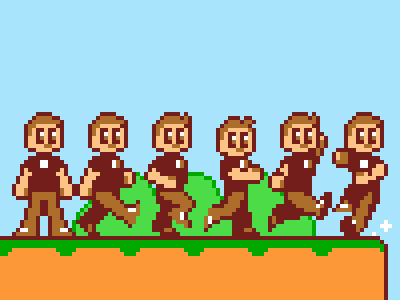
    Further analysis of 8-bit sprites was required.

    Findings: The aesthetically pleasing sprites from early NES platformers tended to feature analogous color schemes, shied away from absolute black outlines, and even though four colors were available artists limited their sprites to three (the most common fourth color being white).

    Conclusions: An absolute black outline makes the sprite look as if it is sitting atop rather than inhabiting a level. An analogous color scheme makes it easier for the eye to track the sprite as a single unit, especially when animated.

    Also, if Twitter drove the car that ran over my blog, Dribbble was the ambulance driver that stopped for a leisurely lunch (and maybe caught a movie) on the way to the hospital. DOA.

    over 2 years ago

  2. Pro Dc-2012 Dan Cederholm

    Totally fascinating. I feel like we're getting a crash course in game design (for free) with your shots.

    Hope there's a merchandise strategy for Mimeo as well. Need t-shirts and prints of this asap. Thx.

    over 2 years ago

  3. Pro Mtn_rogie Rogie

    Shaun, I absolutely love the new changes and the sprite animation with the partially bent knee. Rock on.

    Also, Mimeo now has a new rounder face vs. the old mockup with a taller head. Good call.

    over 2 years ago

  4. Grug-avatar Erik Sagen

    Shaun: This is deserving of a companion "making-of" booklet or something. Love the last animation state - looks like he's making a mad dash.

    over 2 years ago

  5. Pixelavatar_large_16_color Chris Wallace!

    Shaun is a 2009 design genius trapped in the body of a 1987 video game developer.

    over 2 years ago

  6. Pro E2759990ebc89771801a8e31caafede2ef6c7289_full Sebastiaan de With

    With Dan here, it's like a documentary on the sprite design of retro games. Following it closely.

    over 2 years ago

  7. Img_3386 Stephanie Tate

    tshirts would be grrrreat! I like sprites.

    over 2 years ago

  8. Pro Avatar-large2 Dave Shea

    Was thinking about the progression from 2-bit to 16-bit today, and realized you had three ways you could do it.

    The simple, easy way that you're probably planning on doing: out of say, 16 arbitrary levels, you'd have four 2-bit, four 3-bit, four 8-bit, and four 16-bit, leading to a nice logical progression. Each level would have a set bit level, done.

    The more interesting, but harder way would be if each of those levels had all four bit levels baked in. You start the game in two-bit, then you collect power ups and progressively add richness to the game. You get hit by an enemy or the clock runs down below a certain level or something, and you lose richness. (I think the clock model works better, personally, that way you'd likely be able to spend more time in 16 bit and less in 2 bit.)

    No real conclusions, just thought it might be worth comparing the two approaches and seeing which model works better.

    over 2 years ago

  9. Pro Si-tn Shaun Inman

    I was actually planning on having all four bits baked in to each level. Dynamic upscaling and downsampling will be required to unlock hidden levels and beat some challenges.

    A simple example. There may be a wall that is too high to jump as 2-bit Mimeo but when you upgrade to 4-bit a platform appears making passage possible. Or maybe an impassible wall exists in 16-bit that disappears if you downsample to 8-bit.

    I was also thinking that enemy/boss weakness might only be visible at certain resolutions. For example, its attack is easier to dodge as 16-bit but to do damage you need to downsample to 2-bit.

    Once you achieve a certain bit level you can switch back and forth to lower levels as long as you have enough bits in reserve or don't get hit.

    That's the plan anyways, play-testing might change that though.

    over 2 years ago

  10. Pro Si-tn Shaun Inman

    Another example, in one of my level comps there's a platform protruding from a wall that's fully integrated in 8- and 16-bit that appears when you make the jump from 2- to 4-bit. In 2-bit there's a hole with a dashed outline of a block. In 4-bit the block appears (the interior pattern is reversed out so you can tell that it's not a native 4-bit block). But once you upgrade to 8-bit it looks like any other normal block. So in some cases you will need to scrub certain areas to find all the secrets.

    over 2 years ago

  11. Pro Si-tn Shaun Inman

    Dan, if you want a real game design education (okay, maybe not real) I highly recommend the Critical-Gaming blog. His Measure of Mario series was phenomenal and will make you appreciate the games that much more.

    over 2 years ago

keyboard shortcuts: previous shot next shot L or F like